

What Is a Herniated Disc?
What Is a Herniated Disc? Causes, Symptoms, Treatment & How to Heal
Table of Contents
A herniated disc happens when the soft inner material of one of the discs between your spinal bones pushes through a weakened or torn area in the disc's tougher outer layer. Some herniated discs cause no symptoms. Others can irritate or press on a nearby nerve, leading to back or neck pain, burning or shooting pain into an arm or leg, numbness, tingling, or muscle weakness.
The encouraging part is that a herniated disc does not automatically mean surgery. Many people improve over time with conservative care and appropriate activity. The right treatment depends on where the disc is affected, whether a nerve is involved, the severity of your symptoms, and whether you have neurological warning signs.
If you are trying to understand what is a herniated disc, what caused your symptoms, whether it can heal, and what treatment options are available, this guide covers the questions that matter most.
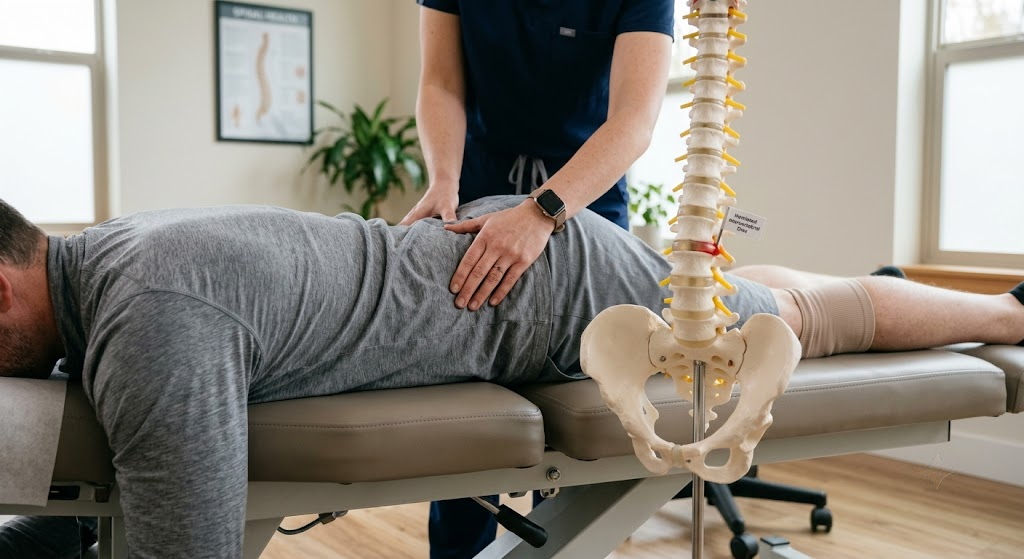
What Is a Herniated Disc?
Your spine is made up of vertebrae separated by intervertebral discs that help absorb force and allow your spine to move.
Each disc has two main parts:
Annulus fibrosus: the stronger outer layer of the disc.
Nucleus pulposus: the softer, gel-like center.
A herniated disc develops when part of the inner disc material pushes through a crack or weak area in the outer layer.
The herniated material does not always cause pain. Symptoms are more likely when it irritates or compresses a nearby nerve.
Herniated discs occur most often in the lumbar spine, or lower back, but they can also occur in the cervical spine of the neck.\
Quick Answer
A herniated disc is damage to a spinal disc that allows some of its softer inner material to extend through its outer layer. If nearby nerves become irritated, it can cause pain, numbness, tingling, or weakness in the back, neck, arms, or legs.
Is a Slipped Disc the Same as a Herniated Disc?
Usually, yes.
“Slipped disc” is a common everyday term for a herniated disc. You may also hear terms such as:
Ruptured disc
Prolapsed disc
Disc extrusion
Disc herniation
A disc does not literally slide out from between the vertebrae. Instead, part of the disc changes shape or pushes through a weakened portion of its outer layer.
“Herniated disc” is therefore the more anatomically accurate term.
Bulging Disc vs. Herniated Disc: What's the Difference?
A bulging disc and a herniated disc are related, but they are not exactly the same.
| Feature | Bulging Disc | Herniated Disc |
|---|---|---|
| Disc shape | Broad outward extension | More focal displacement |
| Outer layer | Usually remains contained | May have a tear or fissure |
| Inner material | Generally contained | Can extend through the outer layer |
| Symptoms | May cause no symptoms | May irritate nearby nerves |
| Common causes | Often degeneration | Degeneration, strain, or injury |
One important point: the MRI appearance alone does not determine how much pain someone will have.
Some people have disc changes on imaging without experiencing pain, while others develop significant symptoms when a nerve becomes irritated.
What Causes a Herniated Disc?
If you are wondering what causes a herniated disc, the answer is often a combination of natural disc changes and mechanical stress rather than one dramatic injury.
Age-Related Disc Changes
As discs age, they may gradually lose some flexibility and resilience. This can make the outer layer more vulnerable to small tears.
Lifting and Twisting
Heavy lifting—particularly while bending, twisting, or using poor lifting mechanics—can place additional stress on the lower back.
Repetitive Stress
Jobs or activities involving frequent bending, twisting, lifting, or prolonged sitting may contribute to repeated spinal stress.
Sudden Injury
Falls, sports injuries, auto accidents, and other traumatic events can sometimes contribute to disc injury.
For many people, however, it is impossible to identify one exact moment when the herniation occurred.
Herniated Disc Risk Factors
Factors associated with a greater likelihood of disc problems include:
Increasing age
Repetitive lifting or twisting
Physically demanding work
Prolonged sitting
Smoking
Excess body weight
Limited physical conditioning
Family history or genetic susceptibility
Having one of these risk factors does not mean you will develop a herniated disc. Likewise, physically active and otherwise healthy people can still experience one.
What Does a Herniated Disc Feel Like?
A herniated disc can feel very different from one person to another.
Some people experience only localized back or neck pain. Others feel symptoms travel along the path of an irritated nerve.
Common descriptions include:
Sharp pain
Burning pain
Electric or shock-like pain
Pins and needles
Numbness
Tingling
Muscle weakness
Pain traveling into an arm or leg
Some herniated discs cause no noticeable symptoms at all.
Herniated Disc Symptoms in the Lower Back
A lumbar disc herniation can cause:
Lower-back pain
Pain through one buttock
Pain traveling down the thigh, calf, or foot
Sciatica
Numbness or tingling in the leg or foot
Weakness in the leg
Symptoms aggravated by certain movements, sitting, coughing, or sneezing
Interestingly, leg symptoms can sometimes be more noticeable than the back pain itself.
Herniated Disc Symptoms in the Neck
A cervical herniated disc may cause:
Neck pain
Shoulder or shoulder-blade pain
Pain traveling down the arm
Tingling or numbness in the hand or fingers
Arm or hand weakness
The exact symptom pattern depends partly on which nerve is being affected.
Is Herniated Disc Pain Different From Muscle Pain?
It can be.
A muscle strain commonly causes localized soreness, tightness, or pain with movement.
Nerve irritation from a herniated disc may produce symptoms that travel away from the spine, such as burning, tingling, numbness, or electric-like pain running down a leg or arm.
However, symptoms alone cannot reliably tell you exactly what structure is responsible.
That is one reason a physical and neurological examination can be valuable when pain is persistent, radiating, severe, or associated with weakness.
How Is a Herniated Disc Diagnosed?
A diagnosis usually starts with your health history and a physical examination rather than immediately with an MRI.
A healthcare professional may ask:
Where does the pain start?
Does it travel into your arm or leg?
Do you have numbness or tingling?
Have you noticed weakness?
Which movements make symptoms better or worse?
Did symptoms begin after an injury?
Are symptoms affecting walking, sleep, work, or everyday activities?
The examination may include checking:
Muscle strength
Reflexes
Sensation
Range of motion
Walking
Leg or arm symptoms
Nerve tension signs
A straight-leg raise test may also be used when lumbar nerve-root irritation is suspected.
Do You Need an MRI for a Herniated Disc?
Not everyone with back pain or suspected disc irritation needs immediate imaging.
For uncomplicated acute low-back pain without red flags, the American College of Radiology considers routine initial imaging—including MRI—to usually be unnecessary. Imaging becomes more important when there are serious warning signs, progressive neurological changes, persistent symptoms in certain circumstances, or when the results would change treatment decisions.
When imaging is appropriate, an MRI can provide detailed information about discs and nerve structures.
Can an X-Ray Show a Herniated Disc?
A standard X-ray does not directly show the soft disc herniation itself.
X-rays may still be useful when a clinician needs information about bones, alignment, fractures, or other possible causes of symptoms.
MRI provides much better visualization of spinal discs, nerves, and other soft tissues.
When Is a Herniated Disc an Emergency?
Most herniated discs are not emergencies.
However, certain symptoms require urgent medical assessment.
Seek emergency medical attention if back pain or leg symptoms occur with:
New loss of bladder control
New loss of bowel control
Numbness around the groin, genitals, buttocks, or inner thighs
Rapidly worsening leg weakness
Severe difficulty standing or walking because of neurological weakness
These can be signs of significant nerve compression, including cauda equina syndrome, which requires prompt medical attention.
You should also seek medical evaluation for severe or worsening neurological symptoms or when symptoms follow significant trauma.
Can a Herniated Disc Heal?
Yes. Many symptomatic herniated discs improve without surgery.
The body can gradually reduce inflammation around the affected nerve, and in some cases displaced disc material can shrink or be resorbed over time.
That does not mean every damaged disc returns to its exact pre-injury appearance.
More importantly, people can experience substantial symptom and functional improvement even when some disc changes remain visible on imaging. Major medical centers report that many people recover without surgical treatment.
Can a Herniated Disc Heal Without Surgery?
Often, yes.
Nonsurgical management is usually considered first when there is no emergency neurological problem.
The appropriate plan depends on your symptoms, examination findings, general health, neurological status, and how your condition changes over time.
What Is the Treatment for a Herniated Disc?
There is no single treatment that works for every herniated disc.
Treatment typically focuses on:
Reducing pain and nerve irritation.
Maintaining safe movement.
Restoring function.
Addressing strength and mobility.
Monitoring neurological symptoms.
Escalating treatment when conservative care is not enough.
Conservative Treatment Options
Depending on your condition, conservative management may include:
Staying Appropriately Active
Extended bed rest is generally discouraged.
A short period of reduced activity may be necessary when symptoms are intense, but gentle activity is often encouraged as symptoms allow.
Heat or Cold
Heat or cold packs may provide temporary symptom relief.
Use whichever is comfortable unless your healthcare provider gives you different instructions.
Medication
Some patients may use over-the-counter or prescription medications under appropriate medical guidance.
Medication choice depends on individual health conditions, other medications, allergies, and medical history.
Physical Therapy and Exercise
Rehabilitation may focus on mobility, strength, gradually returning to activity, and strategies for managing movements that aggravate symptoms.
Epidural Steroid Injections
For selected patients with significant nerve-related pain, physicians may consider an epidural steroid injection to reduce inflammation around an irritated nerve.
Chiropractic Care
Chiropractic care may be considered as one part of conservative musculoskeletal care for appropriately selected patients.
Research summarized by the National Center for Complementary and Integrative Health suggests spinal manipulation may produce modest improvements in pain or function for some people with low-back pain. The evidence does not mean an adjustment physically repairs or pushes a herniated disc back into place.
A proper examination is important before treatment—particularly when symptoms include radiating pain, numbness, tingling, or weakness.
How Chiropractic Care May Fit Into Herniated Disc Management
At Beacon Chiropractic in Floyd, Virginia, care begins by understanding the patient's symptoms and examining how the spine and body are functioning.
The practice offers:
Chiropractic Care
Chiropractic Examination
Chiropractic Adjustment
Nonsurgical Spinal Decompression Therapy
These are confirmed services offered by Beacon Chiropractic.
For someone experiencing back pain or symptoms that may involve a spinal disc, Dr. Adam Murray can perform an examination to determine whether chiropractic care is appropriate or whether the symptoms warrant medical evaluation or another form of care.
Chiropractic Adjustment
A chiropractic adjustment uses controlled force to improve motion in selected spinal or other joints.
When appropriate for the individual patient, it may be included as part of care aimed at supporting mobility and managing musculoskeletal discomfort.
It should not be described as physically “putting a disc back in place.”
Nonsurgical Spinal Decompression Therapy
Beacon Chiropractic also offers Nonsurgical Spinal Decompression Therapy, which uses a decompression table and is intended to reduce mechanical pressure on the spine.
Whether this therapy is suitable depends on the individual's examination, symptoms, medical history, and clinical findings.
It should be viewed as a conservative treatment option for selected patients—not a guaranteed method of repairing or permanently reversing a herniated disc.
How to Treat a Herniated Disc Safely
If you are searching how to treat a herniated disc, start with an accurate assessment rather than assuming every episode of back pain comes from a disc.
A sensible treatment process usually involves:
Identifying your symptoms and neurological status.
Screening for warning signs.
Staying active within tolerable limits.
Avoiding movements that clearly worsen radiating symptoms.
Using conservative treatment when appropriate.
Gradually restoring strength and normal activity.
Reassessing the condition if weakness, numbness, or pain worsens.
Treatment should be individualized rather than based only on an MRI result.
How to Fix a Herniated Disc
People often ask how to fix a herniated disc permanently, but “fix” can be misleading.
Most nonsurgical treatments do not physically repair a tear in the disc.
Instead, recovery usually involves reducing nerve irritation, helping symptoms settle, maintaining or restoring movement, improving function, and giving the body time to recover.
For that reason, a better goal is not necessarily making an MRI look normal. It is helping you return safely to normal movement, work, exercise, sleep, and daily life.
How to Heal a Herniated Disc Quickly
There is no proven overnight treatment for a herniated disc.
If you're wondering how to heal a herniated disc quickly, focus instead on avoiding things that can unnecessarily delay recovery.
Helpful principles include:
Avoid prolonged bed rest.
Stay gently active as tolerated.
Follow professional recommendations when neurological symptoms are present.
Avoid repeatedly provoking severe radiating pain.
Gradually return to normal activity.
Get adequate sleep.
Avoid smoking.
Use safe lifting techniques.
Follow a rehabilitation plan when prescribed.
Be careful with claims that a supplement, food, stretch, adjustment, or machine can “heal a disc fast.”
No single treatment can guarantee how rapidly an individual herniated disc will recover.
How to Relieve Herniated Disc Pain in the Lower Back
While you are recovering, small changes can sometimes make daily life easier.
You may find it helpful to:
Take short, comfortable walks.
Change positions regularly rather than sitting for long periods.
Avoid repeated bending and twisting under load.
Use a comfortable sleeping position.
Try heat or cold for short-term symptom relief.
Keep objects close to your body when lifting.
Follow exercises recommended for your particular presentation.
Be cautious with exercises you find online.
For example, extension exercises may help some people but worsen symptoms in others. If an exercise causes pain to spread farther down the leg, produces new numbness, or increases weakness, stop and seek professional guidance.
How Long Does It Take to Recover From a Herniated Disk?
There is no universal recovery date.
Many people begin feeling better within several weeks, while others require a longer period of rehabilitation and treatment. Cleveland Clinic notes that many patients improve with time and nonsurgical care, while Mayo Clinic likewise states that symptoms often improve without surgery.
Recovery can depend on:
Location of the herniation
Degree of nerve irritation
Muscle weakness
General health
Activity level
Smoking
Type of work
Previous spinal problems
Treatment needs
A person with mild pain and no neurological deficit may have a very different recovery process from someone experiencing persistent sciatica and weakness.
When Should You Get Re-Evaluated?
Talk with a healthcare professional if:
Symptoms continue to significantly interfere with daily activities.
Pain is worsening instead of improving.
Numbness or tingling increases.
You develop weakness.
Walking becomes difficult.
New neurological symptoms appear.
When Is Surgery Considered?
Most people with a herniated disc do not automatically need surgery.
Surgical evaluation becomes more relevant when there is:
Progressive neurological weakness
Significant nerve compression
Cauda equina syndrome
Severe symptoms that do not improve with an appropriate period of conservative treatment
Persistent functional impairment despite nonsurgical care
One common surgical procedure is a microdiscectomy, in which the surgeon removes disc material that is compressing a nerve.
The decision should be based on the individual's symptoms, examination, imaging when indicated, functional limitations, and response to conservative treatment.
How Can I Avoid Getting a Herniated Disk?
Not every herniated disc is preventable, particularly when genetics and natural disc degeneration contribute.
You can still reduce unnecessary strain on your spine.
Helpful habits include:
Exercise regularly.
Build appropriate trunk, hip, and back strength.
Use good lifting mechanics.
Keep heavy loads close to your body.
Avoid twisting while lifting.
Break up long periods of sitting.
Maintain a healthy weight when possible.
Avoid smoking.
Gradually increase exercise or workload rather than making sudden jumps.
The goal is not to keep your spine perfectly still. A healthy spine needs regular, appropriate movement.
Frequently Asked Questions About Herniated Discs
What is the main cause of a herniated disc?
A herniated disc often develops from gradual age-related changes that make the outer portion of the disc less resilient. Lifting, repetitive bending or twisting, and injuries may then contribute to the disc herniating.
Can a herniated disc heal on its own?
Yes. Many people improve with time and conservative care, and some herniated disc material can shrink or be resorbed naturally. Improvement does not necessarily mean the disc returns to its exact previous appearance.
What is the treatment for a herniated disk?
Treatment often begins conservatively and may include appropriate activity, symptom management, physical rehabilitation, medication when medically appropriate, and other nonsurgical approaches. Selected patients may also consider chiropractic care. Injections or surgery may be considered when symptoms or neurological findings warrant them.
How do you fix a herniated disc?
There usually is not a single procedure that simply “fixes” a herniated disc. Conservative treatment focuses on reducing symptoms, restoring function, supporting movement, and allowing natural recovery. Surgery may be considered when serious or persistent nerve compression is present.
How long does it take to recover from a herniated disk?
Many people notice improvement over several weeks, but recovery varies considerably. Nerve involvement, weakness, health, lifestyle, severity, and the type of work or activities you need to return to can all affect the timeline.
Can walking help a herniated disc?
Gentle walking is often a practical way to remain active when it does not significantly increase symptoms. Start with a comfortable amount and increase gradually. Stop and seek guidance if walking produces worsening weakness, numbness, or severe radiating pain.
Can sitting make a herniated disc feel worse?
It can for some people. Prolonged sitting may aggravate lumbar symptoms, particularly when nerve irritation is present. Changing positions periodically may make symptoms more manageable.
Does a herniated disc always cause sciatica?
No. Sciatica can occur when a lumbar disc irritates a nerve contributing to the sciatic nerve, but not every herniated disc affects those nerves. Some herniated discs cause localized pain, different nerve symptoms, or no symptoms.
Does every herniated disc need an MRI?
No. Routine immediate imaging is generally not needed for uncomplicated acute low-back pain without warning signs. MRI becomes more useful when neurological deficits, serious conditions, persistent symptoms, or treatment decisions make imaging clinically important.
Can chiropractic care cure a herniated disc?
Chiropractic treatment should not be described as curing or physically repairing a herniated disc. Depending on the individual, conservative chiropractic care may be considered for managing certain musculoskeletal symptoms and supporting mobility. An examination should determine whether it is appropriate.
Herniated Disc Care in Floyd, Virginia
Back pain, leg pain, tingling, or reduced mobility does not automatically tell you that you have a herniated disc.
The first step is understanding what may be causing your symptoms.
At Beacon Chiropractic in Floyd, VA, Dr. Adam Murray provides chiropractic examinations and individualized conservative care. Depending on your examination and needs, available services include chiropractic adjustments and nonsurgical spinal decompression therapy.
If your symptoms suggest that chiropractic treatment is not appropriate or that further medical evaluation is needed, those warning signs should be addressed before treatment.
Ready to Have Your Back or Leg Symptoms Evaluated?
If ongoing back pain, stiffness, radiating leg discomfort, or limited movement is affecting your day, schedule a chiropractic examination with Dr. Adam Murray at Beacon Chiropractic in Floyd, Virginia.
An examination can help determine whether conservative chiropractic care is appropriate for your symptoms and what your next step should be.
Location: Beacon Chiropractic - Floyd, VA
Website: Chiropractic in Floyd, VA
Phone: (540) 745-4450
About the Author
Dr. Adam Murray, DC
Dr. Adam Murray is the founder and chiropractor at Beacon Chiropractic in Floyd, Virginia. He is dedicated to providing personalized chiropractic care that helps patients improve movement, manage pain, and support their overall health and wellness.
Dr. Murray earned his Bachelor of Science degree from Virginia Tech before completing his Doctor of Chiropractic degree at Life University. He is board certified through the National Board of Chiropractic Examiners and has additional certifications in radiology, physiotherapy, chiropractic practice and philosophy, and myofascial taping techniques through RockTape.
His clinical approach focuses on individualized chiropractic care for patients of all ages, including families, athletes, children, and older adults. His areas of care include chiropractic adjustments, spinal health, nonsurgical spinal decompression therapy, mobility, and wellness-focused chiropractic care.
Helpful Articles

All Services
Learn More
Keep
In Touch
MAP
Powered by: